Flow Rate In A Large Planted Aquarium

With a high emphasis on flow rate in a planted aquarium I found this latest video which Mark Evans shot, very interesting.

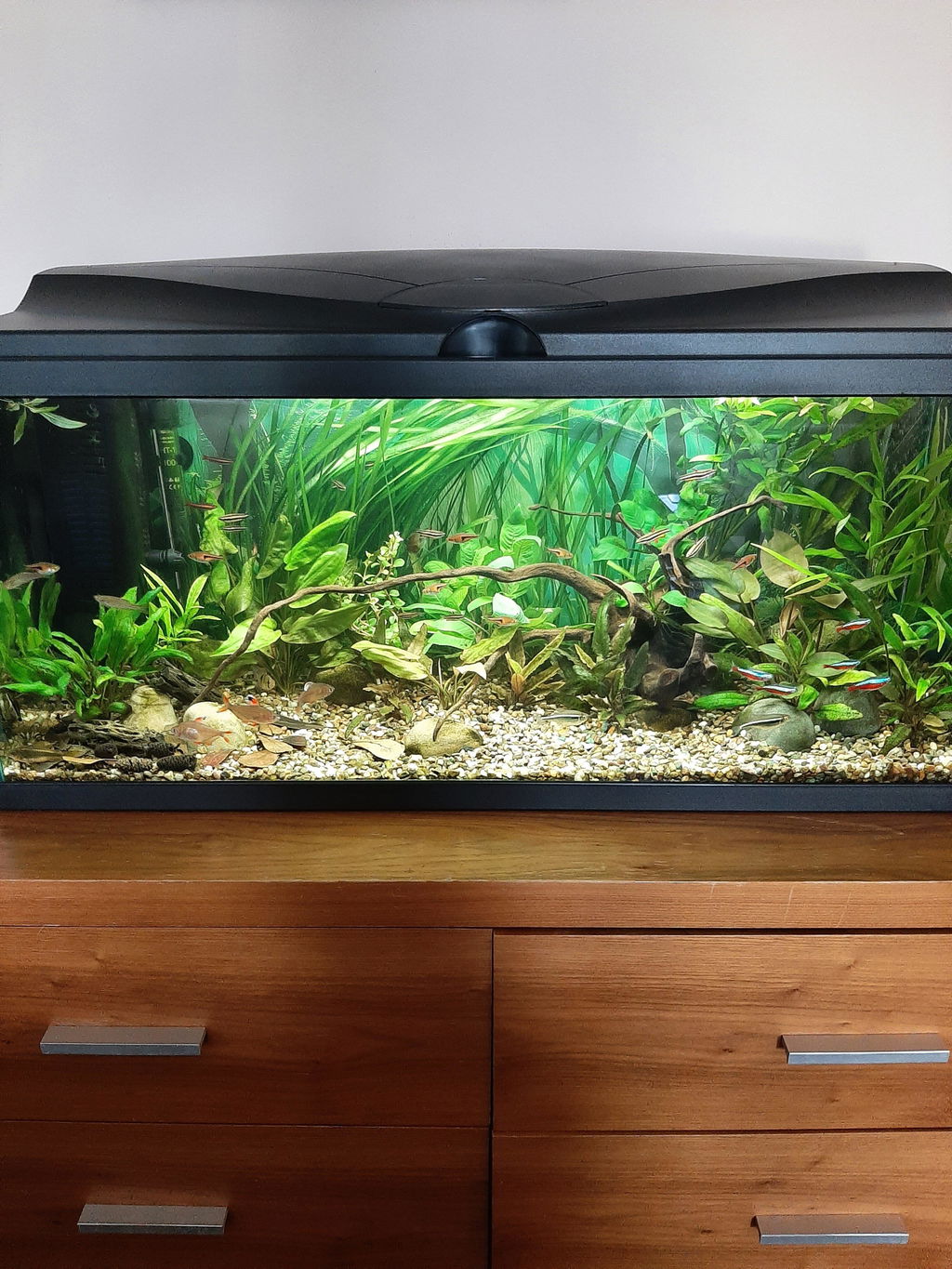
The general idea is that you filter 10 times the tank volume of water per hour so if your tank is 100L, you would look to have a filter that filters 1000L per hour. Fairly straight forward right? But in a larger aquarium is this necessary? I always thought it was until today. Mark’s aquarium is large, 363L. Previous calculations would mean the filter/s would need to move 3630L per hour but it’s quite a lot less this time and the flow rate is 2600lp/h and as you can see from the results, it’s pretty incredible. Flow rate is much slower but with no negative impact.

Interestingly enough the CO2 is also fed into the external filter via the inlet and the results mean that you don’t have thousands of tiny bubbles floating around the tank. The diffuser is an UP 16mm Inline Diffuser – in the past these have always been plumed in on the outlet but I do like the idea of not having to look at all the bubbles…

A lot of people ask where they should place their powerheads or filter outlets in order to get the right sort of water movement and as you can see from the clip, a large spraybar is positioned which pushes the water across the tank and at the opposite side is a lily pipe positioned very close to the water surface. Now I’m not sure if this is to keep the surface polished or if it’s another reason. Maybe if Mark reads this post he could enlighten us :) What I do like to see is some water movement at the surface and it’s clear that there is a gentle ripple – this makes the water shimmer a little too along with the help of his metal halide lighting. In the past hobbyists were keen on maximum Co2 absorption and kept the surface almost still which caused nothing but problems. Dust would build up very quickly and then this could turn green blocking off light.

I also like his positioning of the drop checker. Right under the spray bar – odds are he won’t have a great deal of flow around there so if the drop checker is green there, you can bet it’s bang on for the rest of the aquarium.

All in all, you can see Mark does things a little differently to most hobbyists and this is why he gets such super results. He tries, experiments and learns and his skills are getting better and better all the time.

I would love to hear what other people think of his tank and also where they position their drop checker.

Cal Aqua Nano Drop Checker

Most of you are pretty familiar with drop checkers and I have written about them on here before. If you’re not (do a quick search on our blog), they’re a must have product for a planted aquarium without any question of doubt. They measure your CO2 levels in your planted aquarium.

All drop checkers work in the same manner but all differ in looks and shape and the new Cal Aqua Nano Drop Checker has to be one of the smartest drop checkers I have ever seen. It’s so delicately made and so tiny at a mere 3x3cm you could easily lose it in your planted aquarium. Whilst you don’t of course want to lose it, keeping as much equipment out of the tank is the idea as it distracts from the aquascape. Any equipment in the tank should ideally be glass (where ever possible).  This drop checker comes with everything you need too – 15ml of bromo blue which means that when your solution turns green, you have the ideal CO2 levels in your planted aquarium (30 ppm). It also comes with a clear suction cup.

Although aimed towards smaller aquariums I personally think it’s suitable for all sizes of aquariums from the very small to the very large. Positioning wise, try placing it under your filter outlet – this will give you a really good idea as to your CO2 levels in your tank.

Are you using a Cal Aqua Nano Drop Checker in your tank? We would love to see a picture.

CO2 Drop Checkers

Drop Checkers are an important piece of equipment in a planted aquarium. In fact without a drop checker how do you actually know what your CO2 levels are? They work by measuring the pH levels in your aquarium. A small amount of test reagent is placed in your drop checker and changes colour according to your CO2 levels. The ideal colour to aim for is green and if you have too little CO2 it becomes blue and too much, become yellow.

Available in a variety of shapes and sizes, some glass, some plastic but they all do the same job. The only difference is that most of them are supplied with a reagent that doesn’t work properly and as a result will give false readings. If you have a drop checker and you use tank water and an orange reagent to measure your CO2 levels, then you need to change (this is the old fashioned/incorrect way) but we’ll get onto that shortly.

All drop checkers need to use 4dkh bromothymol blue solution. This solution is the most accurate on the market and once placed in your drop checker provides accurate results. In a planted aquarium the desired CO2 level for optimum plant growth is 30ppm. When your aquarium has this amount of CO2 in it, your drop checker will turn green – this is why it’s so important. So why shouldn’t you use tank water and the orange reagent that most drop checkers come with?

Tank water contains a variety of acids and alkalines some created by fish and shrimp, others added by hobbyists in the form of fertilisers for their plants.  Therefore by using tank water in your reagent you’re adding a solution that is already changing and this is no good if you want accurate results – you need to start with a stable base level and go from there. This is where the 4dkH bromothymol blue solution comes in handy.

For more information on this subject you can visit this link.

Here’s a nice picture of a drop checker changing colour

Drop Checker changing colour